Just-Dub-It
Video Dubbing via Joint Audio-Visual Diffusion
Experience seamless lip synchronization and voice personality preservation across multiple languages.
A joint audio-visual model is all you need for video dubbing.




JUST-DUB-IT maintains speaker identity and precise lip synchronization across any target language,
while demonstrating robustness to complex motion and real-world dynamics.
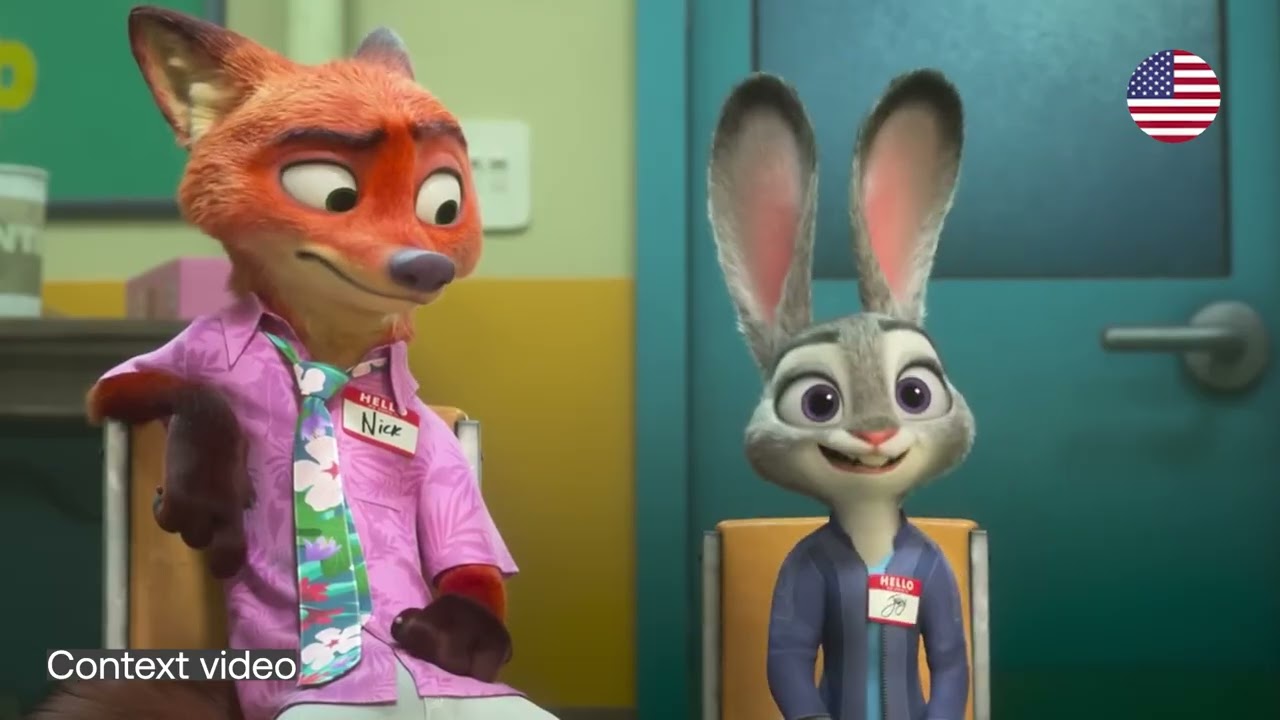
Introduction Video
Click to watch on YouTube
Diverse Results






JUST-DUB-IT achieves high fidelity and robust synchronization across diverse scenes.
Better than state-of-the-art
Compare our results with existing baselines across different languages and speakers.
Zootopia 2 Trailer

Source

JUST-DUB-IT
LatentSync
LatentSync corrupted for this case

HeyGen
HeyGen fails and returned identical video with dubbed audio, which is out of sync
The Mask (Jim Carrey)

Source

JUST-DUB-IT

LatentSync
LatentSync generates blurry video and fail to preserve the original duration.

HeyGen
HeyGen fails on this case, naively copy-pasting the original video.
Hans Landa

Source

JUST-DUB-IT

LatentSync

HeyGen
Bus Stop (Russian Dub)

Source

JUST-DUB-IT

LatentSync

HeyGen
Larry David at a restaurant

Source

JUST-DUB-IT

LatentSync

HeyGen
Abstract
Audio-Visual Foundation Models, which are pretrained to jointly generate sound and visual content, have recently shown an unprecedented ability to model multi-modal generation and editing, opening new opportunities for downstream tasks. Among these tasks, video dubbing could greatly benefit from such priors, yet most existing solutions still rely on complex, task-specific pipelines that struggle in real-world settings.
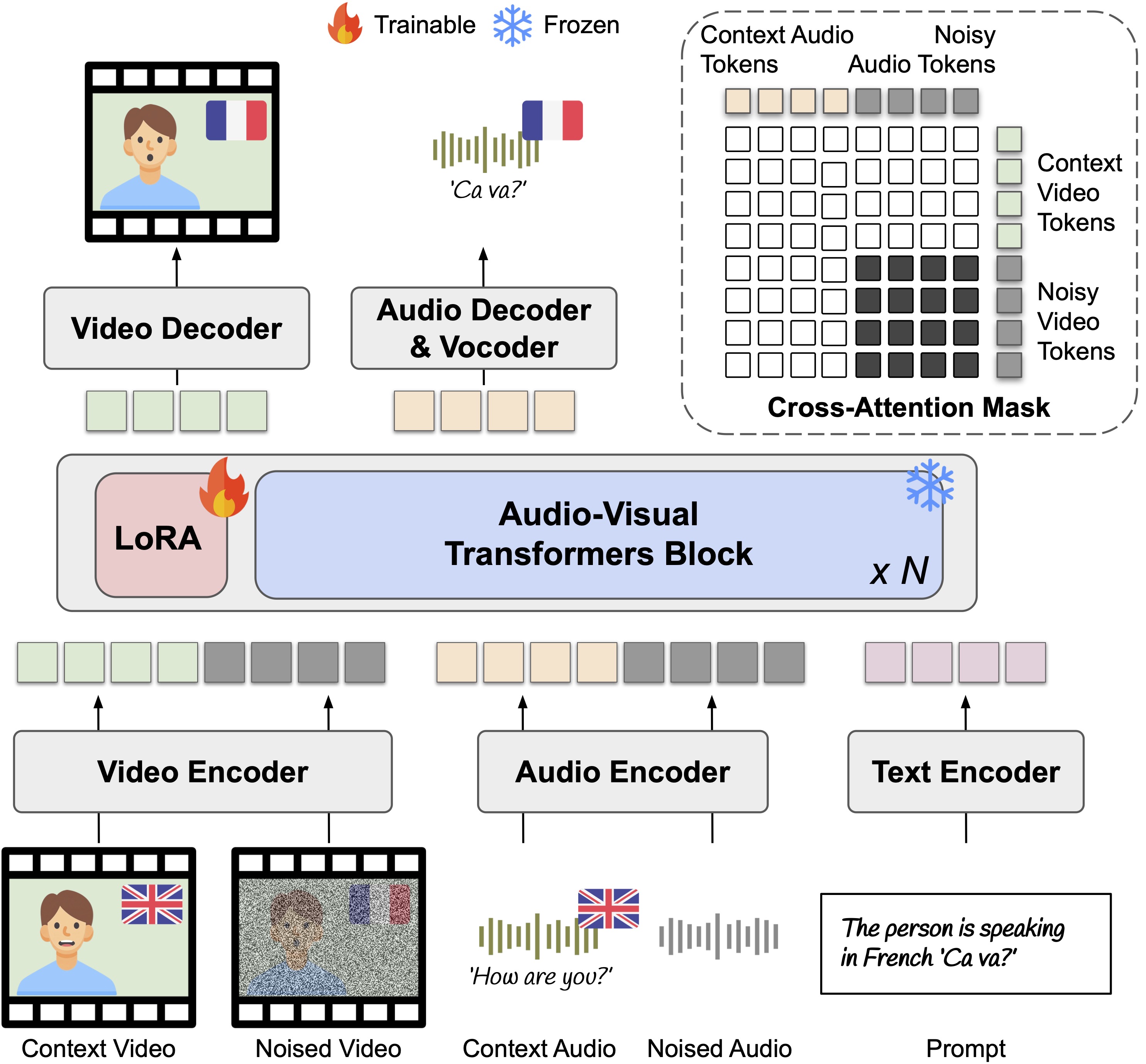
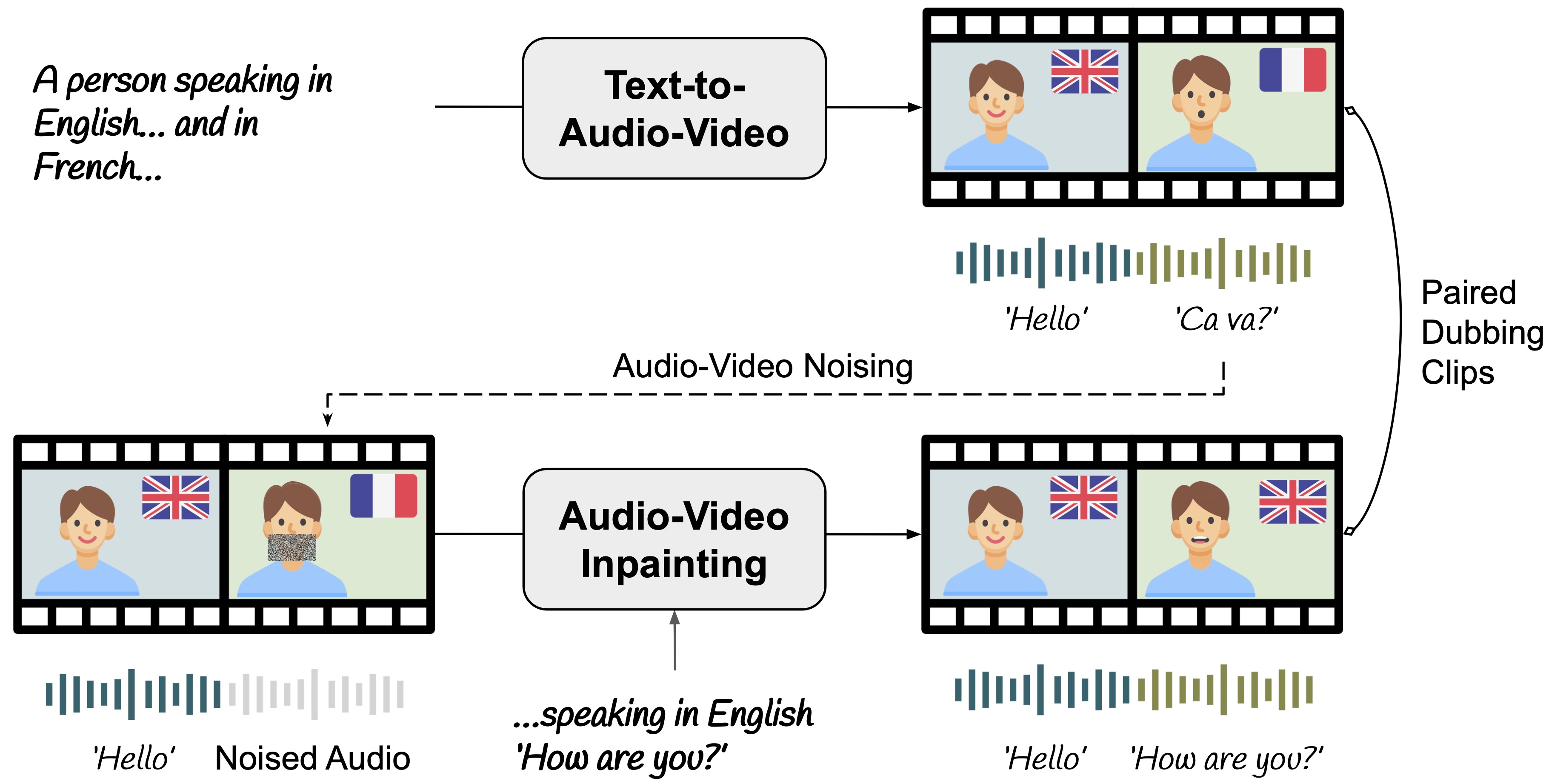
In this work, we introduce a single-model approach that adapts a foundational audio-video diffusion model for video-to-video dubbing via a lightweight LoRA. The LoRA enables the model to condition on an input audio-video while jointly generating translated audio and synchronized facial motion. To train this LoRA, we leverage the generative model itself to synthesize paired multilingual videos of the same speaker. Specifically, we generate multilingual videos with language switches within a single clip, and then inpaint the face and audio in each half to match the language of the other half.
By leveraging the rich generative prior of the audio-visual model, our approach preserves speaker identity and lip synchronization while remaining robust to complex motion and real-world dynamics. We demonstrate that our approach produces high-quality dubbed videos with improved visual fidelity, lip synchronization, and robustness compared to existing dubbing pipelines.
Method
Synthetic Data Pipeline
- · Language-Switching: Establishing ground-truth identity references via natural bilingual transitions.
- · Counterfactual Inpainting: Generating perfect multilingual pairs with identical pose/background.
- · Latent-Aware Masking: Eliminating motion leakage by computing the effective receptive field in latent space.
In-Context LoRA Training
- · Structural Anchoring: Leveraging source latents as anchors for context-aware completion.
- · Isolated Cross-Attention: Structured bias (Matrix M) to prevent cross-modal signal leakage.
- · Unified Signal Flow: Adapting joint audio-visual priors via efficient, lightweight LoRA adapters.